After 12 years, players in the National Hockey League (NHL) are returning to the sport of ice hockey in the 2026 Milano Cortina Winter Olympic Games which are being held on Feb. 6 through 22. Five St. Louis Blues players, Stanley Cup-winning goaltender Jordan Binnington and defenseman Colton Parayko (Team Canada), forwards Pius Suter (Team Switzerland), Philip Broberg (Team Sweden), and rookie forward Dalibor Dvorský (Team Slovakia), all made Olympic Ice Hockey team rosters in December.
-
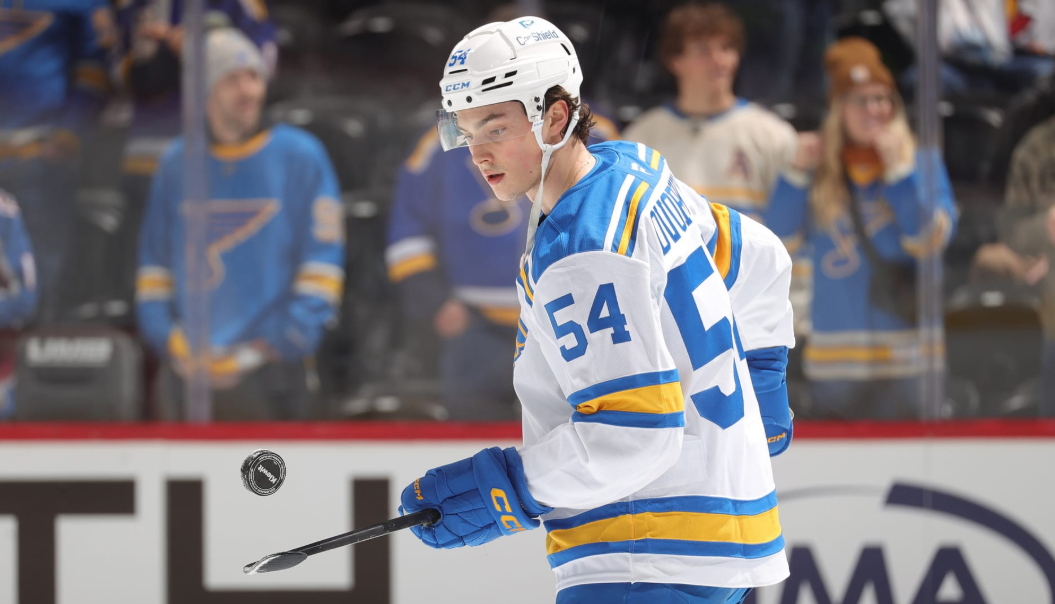
20-year-old forward Dalibor Dvorský juggles a puck during warm-ups before a game on Dec. 31 versus the Colorado Avalanche. Being his rookie season, this will be Dvorský’s first chance to play on the world stage. (photo from St. Louis Blues)
-
Forward Philip Broberg (6) blocks Edmonton Oilers forward Zach Hyman (18) with his stick in a game versus the Oilers on Jan. 18. Broberg will represent Team Sweden, which consists of National Hockey League players from 17 different teams. (photo from St. Louis Blues)

-
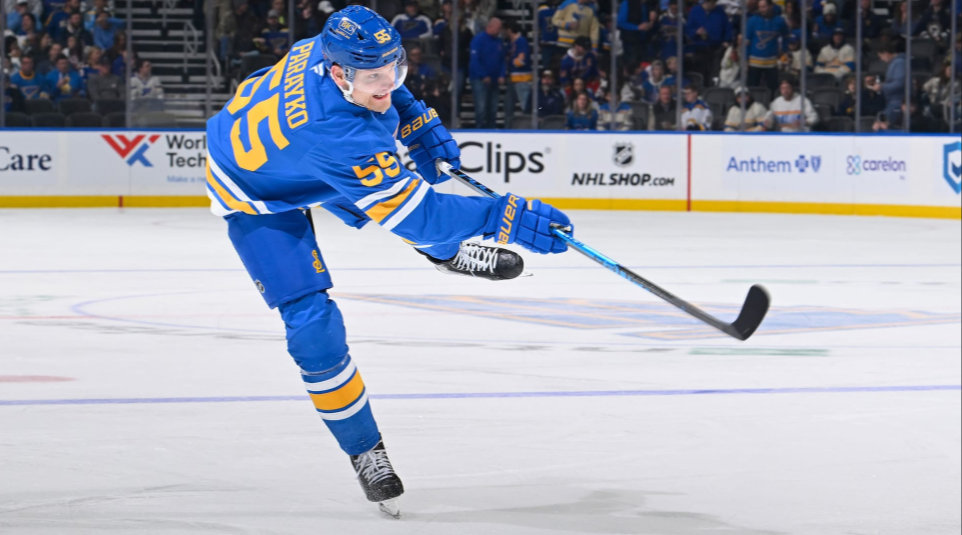
Long-tenured defenseman Colton Parayko takes a shot at the goal in a game on Dec. 27. Parayko was selected out of around 300 Canadian National Hockey League players to represent Canada at the upcoming Winter Olympics. (photo from St. Louis Blues)
-
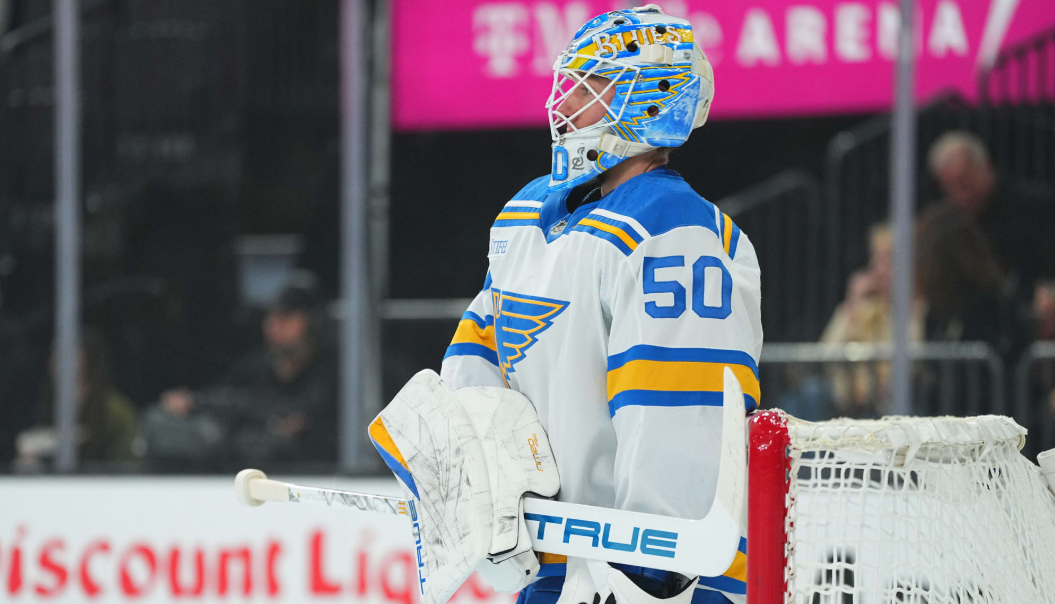
Looking down the ice, goaltender Jordan Binnington stands in front of the goal before a game on Jan. 10. Hopes are high for Binnington as he performed very well at his last appearances in off-regular season events like the 2025 Four Nations Face-Off and the 2020 All-Star Game and Skills Competition. (photo from St. Louis Blues)
-
Forward Pius Suter waits for the referee to drop the puck in a faceoff in a game against the Nashville Predators on Dec. 27. Suter, born in Wallisellen, Switzerland, will represent the European country at the 2026 Winter Olympics. (photo from St. Louis Blues)

-
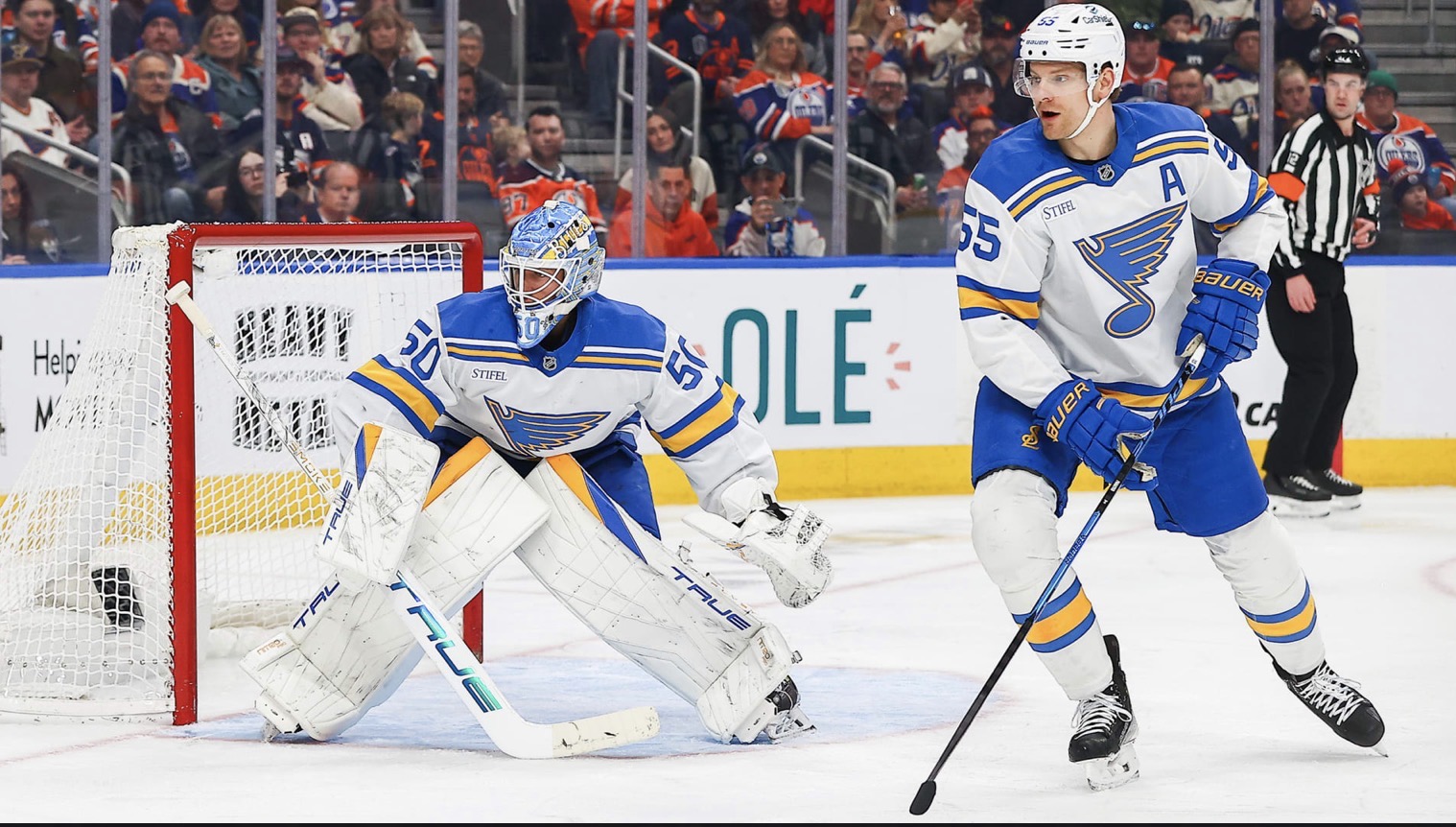
In a game against the Edmonton Oilers on Jan. 18, goaltender Jordan Binnington (50) and defenseman Colton Parayko (55) guard the net. The two will join 23 other players to form Team Canada at the 2026 Winter Olympic Games in Milan and Cortina d’Ampezzo, Italy. (photo from St. Louis Blues)





Since the 2014 Sochi Winter Olympic Games, NHL players have been excluded from participating in the Olympics due to scheduling, costs, and concerns of player injury. However, recent agreements have welcomed back these players, allowing 146 players chosen from the league to participate.
Being selected for any Olympic team is a big deal, and the feeling is mutual for the NHL players. Despite playing for Team Canada in the Four Nations Face-Off last season, among other opportunities such as All-Star games, long-tenured goaltender Binnington said in an interview with Blues broadcaster Andy Strickland on Dec. 31 that the opportunity to play at the Olympics is a special one.
“[Being on the Olympic team] is big. It’s intense. It’s an incredible opportunity, and it’s where you want to be. So, I’m grateful and excited to get to work, and that my buddy, [Parayko], we get to go there together,” Binnington said.
As of Jan. 22, the Blues are 19-23-8 and are ranked seventh out of eight in the Central Division of the NHL with 41 points on the season. The team has only been able to hold a 2-game win streak since October.
Throughout the season, scouts for the Olympic Ice Hockey teams have been observing players during their regular NHL games. Parayko explained in the interview with Strickland that staying in the moment, trying your best, and letting everything fall into place is the best course of action when it comes to big opportunities.
“It’s easy to start thinking about different things and trying to get ahead of yourself, [but I’ve been trying] to stick to the process and to things that make me successful as a player, and try to help out the Blues as much as possible,” Parayko said.
Because the regular season break for the NHL takes place Feb. 6-25, players selected to participate in the Olympics will not receive as much time off, depending on how far they make it in the Olympic tournament. However, Senior Head of Hockey Communications and Player Engagement Dan O’Neill said that this is a sacrifice the players are willing to make.
“Their time will be cut short due to their participation but that’s a trade off all of the Olympians are happy to make. The gold-medal game is on Feb. 22 and the Blues restart on Feb. 26. If any of our players make it to the final, I would anticipate that the team will allow them the following three days to rest and recover,” O’Neill said.
With the Olympics comes the opportunity for athletes to play with an all-new team. When asked about being on a team with NHL-leading players such as the Edmonton Oilers’ Connor McDavid, and the Colorado Avalanche’s Nathan MacKinnon, Binnington noted how there are endless chances to grow and gain knowledge from these special events.
“Being around personnel like that, there’s always something to learn. These guys are great for a reason, so it’s been fun building relationships there and gaining experience leading to this. Like [Parayko] said, it’s process-driven. You just [have] to stick to your plan every day, be the best you can be, and just be intentional. And when it comes time, you have to dig in, so we’re very excited for this opportunity,” Binnington said.
Online, videos have surfaced of the newly-built Olympic Ice Hockey rink, Milano Santagiulia Ice Hockey Arena, which has caused discourse due to its smaller size. O’Neill said that the slight size difference between the Olympic rink and a standard NHL one will still impact the players.
“The Olympic rink for 2026 is set to be approximately 196.85 ft x 85.3 ft, compared to an NHL rink that is 200 ft x 85 ft. A three-foot difference in length doesn’t seem like much, but for a [professional] hockey player it will be noticeable. It’s going to demand quicker decision making, especially through the neutral zone,” O’Neill said.
Different rink sizes is only one of the many changes for ice hockey at the Olympics. O’Neill said that there will be many changes to the rules as compared to the normal rules of NHL hockey.
“[There are] several [differences in the rules]. Olympic hockey has automatic icing [(the act of a player shooting the puck all the way down the ice from their side, past the opposing team’s goal line, without anyone touching it, resulting in a delay of gameplay)], versus the NHL that allows a race to the faceoff dot before blowing the whistle. [Other changed rules are that] there are no restrictions on goalie puck handling in the Olympics, fighting is banned in the Olympics – result[ing] in an ejection, and intermissions are 15 minutes in [the] Olympics versus 18 minutes in the NHL,” O’Neill said.
Another key difference for players in the Olympics is the structure of overtime (OT), O’Neill explained.
“[For] overtime in the Olympics [in] preliminary rounds, [there will be a] 5 minute, 3-on-3 sudden death OT, followed by a shootout, [for] quarterfinals/semifinals, [a] 10 minute, 3-on-3 sudden death OT, followed by shootout, [and for] medal games [there will be] 20 minute, 3-on-3 sudden death periods until a winner is determined,” O’Neill said.
Arguably, one of the strongest factors that drives any Olympic Games is the rivalry between countries. Canada, where ice hockey was first created, has much pride in the sport and is relying heavily on the players representing the country to perform to their full potential, Binnington said.
“My wife [is] super excited. It’s obviously a big stage and an incredible opportunity. Growing up, being from Canada, we know how passionate the country is, and we’re playing for the country, [so] it’s our turn to step in there and do it the best we can,” Binnington said.
Drafted by the Blues in 2012 at the age of 19, Parayko had played hockey growing up in his hometown of St. Albert, Alberta before playing junior hockey for the Fort McMurray Oil Barons in the Alberta Junior Hockey League. Parayko described how every step of the way in his hockey career has led him to being able to play at the Winter Olympics.
“[There’s a] wave of emotions, obviously, a lot of things that go through your mind. You think back at the beginning of everything that has happened along the journey from the start. It starts with the family and coaches and friends along the way. Junior coaches, college coaches, coaches in the NHL, and most importantly, teammates. [I’ve had] a lot of amazing teammates throughout my career that have helped me, and I can’t say enough that it’s a cool accomplishment, but there’s so many people behind it that make it special,” Parayko said.
The 2026 Milano Cortina Winter Olympic Games will take place primarily in the alpine ski resort of Cortina d’Ampezzo. Men’s Ice Hockey games begin on Feb. 11, with the gold medal game taking place on Feb. 22.