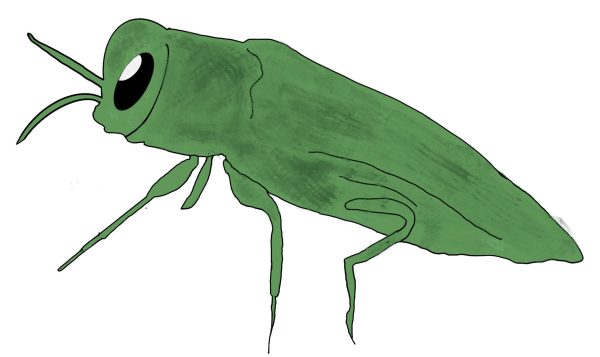
Saint Louis is under attack by the invasive emerald ash borer (EAB), a species of beetle that burrows into and kills all species of ash trees. Since 2002, the insect has been killing trees in the northeastern United States, and as of 2020, the EAB has become widespread throughout Missouri. When the EAB infects a tree, the tree becomes brittle and hollow, posing a significant risk to public safety. Depending on a city’s size, the EAB can eradicate an ash tree population in three to ten years.
There are approximately 15,000 ash trees in St. Louis city, which is around 17 percent of the city’s total tree population. A large amount of ash trees will need to be removed from the downtown area due to the infestation. The city plans to treat large un-infected trees with a botanical pesticide called TreeAzin. The chemical degrades quickly in soil minimizing negative environmental effects, meaning it is safe to use in highly populated and trafficked areas. Every two years the city will be tasked with injecting TreeAzin into the tree. Treated trees have a lower risk of EAB infestation.
The sudden removal of ash trees poses a serious threat to the city’s tree canopy, leading to large areas looking barren and sparse. In addition, the eradication of ash trees poses a significant risk to ecosystems they inhabit. Nearly 100 species of insects rely on ash trees at some point in their life cycle. To remedy this, a local non-profit nursery called Forest ReLeaf of Missouri grows native trees and shrubs. The organization is partnering with St. Louis city to replant removed ash trees.
The Missouri Master Naturalist (MMN) program is a volunteer based community program. MMN and science teacher Sarah Moonier said ash trees will almost certainly be eradicated in Missouri.
“[The EAB has] definitely almost completely killed ash trees. We have a bunch on campus that haven’t survived. Ashes are a food source for some organisms and the loss of ashes will affect [those] organisms. We have ash trees in Missouri but they’re not as frequent as some places. You’ll probably see small ash trees because it infects the tree and basically keeps it from maturing. So any kind of smaller ash trees you’ll still see around, but eventually they won’t be able to reproduce and make new ones,” Moonier said.
To prevent spreading the insect, people should not be transporting infected firewood. Moonier said wood should stay in the county that a tree originated in to stop the EAB from spreading.
“The biggest thing for ashes is not to move firewood. So if you have firewood then you have to keep it within your county, because that’s one of the biggest causes for [the EAB] to move,” Moonier said.