
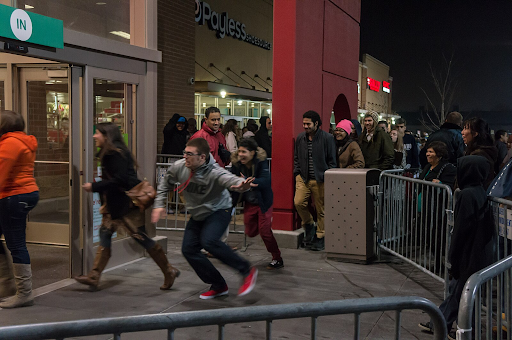
American consumers spent a record $11.8 billion shopping online Black Friday deals, according to Adobe Analytics, despite the lingering economic uncertainty around this year’s holiday season. This makes a 9.1 percent increase from last year’s $10.8 billion.
Following the government shutdown, as well as other economic stressors, many households are dealing with tight budgets for the upcoming holidays. Even with consumer’s reduced pocket sizes, prices continue to rise as companies tussle with the augmenting pressure of tariffs. A common saying related to this holiday season, “paying more for less,” has begun to spread across vast numbers of buyers.
Business teacher Libby D’Angelo said that due to the increase of inflation as well as new tariffs, many people will notice that their carts contain fewer products, while costing higher prices.
“Combining tariffs and inflation, you’re going to see prices going up. If you already [have] a budget in place, it’s not going to go as far. People are buying a lot less because they had a set amount that they were going to spend. But now it has to go to tariffs, inflation, [and] taxes,” D’Angelo said.
Companies have decreased their Black Friday discounts due to the new U.S. tariffs that have increased business cost, leaving distributors with less money to offer grand deals. According to Salesforce, the average market price of goods is rising by seven percent, while customers are reportedly buying two percent less than they have before because of the decreased discounts.
However, there has been an effort by brands to combat increased cost to consumers. Tactics such as value-driven deals, like bundles, have pulled in more clientele for companies, while preserving their margins. Some companies that have participated in this deal include; Bath & Body Works’ buy one, get one (BOGO) promotions, Best Buy’s gadget bundles, and Nike‘s personalized discounts on custom tailored product bundles to individual customers.
D’Angelo said that her greatest piece of advice she can give to upcoming holiday shoppers is to budget and plan accordingly.
“[My first tip is to] have a budget. You want to buy all these gifts, but stick within your budget. Even if tariffs or inflation are going to cause an issue with that, [you] need to stick within your budget. [Second], my big thing is planning ahead. [Ask yourself], how many weeks until Christmas? When do I need to order it? How’s it going to get to me? Also, really research your prices, because somebody might have [the product] in stock in the United States before the tariffs went in place,” D’Angelo said.