In early February, the Summit community was struck by the news that a fellow classmate had entered heart failure. Junior Quincy Rainey, varsity football player and track athlete, left school early on Feb. 4 after not feeling well, and was admitted to the Pediatric Intensive Care Unit (PICU) in compensated heart failure, when one side of the heart is not pumping as it should. There, Rainey would spend the next month and a half.
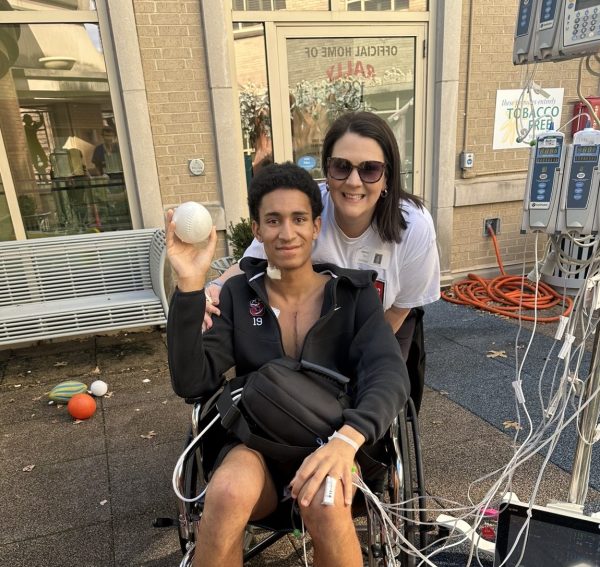
Prior to getting sick at school, Rainey had been dealing with a low-grade fever and suspected bronchitis. He said that he was recommended by his primary doctor to visit the emergency room.
“I was walking up to science class, and then I almost passed out walking up the stairs. So, I went to the nurse, and then we went to the doctor. She told me to go to Cardinal Glennon to check for pneumonia. [There,] they came in and told me that I had cardiomyopathy, and that I was going to be staying for a while,” Quincy said.
Rainey was diagnosed with a rare form of cardiomyopathy called Left Ventricular Non-Compaction (LVNC), which occurs when the heart muscle fails to develop fully during growth in the womb. This congenital condition occurs in only around 0.014% to 1.3% of the general population, mostly going undiagnosed due to lack of symptoms.
Due to his reduced response to medication, the doctors knew that he would need a heart transplant, Quincy’s mother, Michelle Rainey explained.
“[The doctors] decided he needed a transplant because his body was only accepting [intravenous] medication. When they were trying to put him on oral medication, his heart was failing again,” Michelle said.
The doctors performed a cardiac catheterization (cardiac cath) to keep his heart stable while waiting for a transplant. During this procedure, a small tube is guided into the blood vessels in the heart. Michelle explained how this procedure failed, leading to Quincy’s need for another device to help his heart.
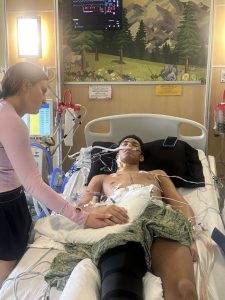
“While we were going through the process of getting approved for transplant, he had a cardiac cath, and that cardiac cath showed too much pressure on his lungs and chest; that’s when he had to get the device that he has in his heart currently, which is a Left Ventricular Assist Device (LVAD),” Michelle said.
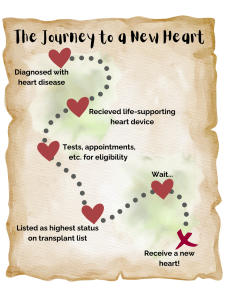
The process to get on the transplant list is intricate and lengthy. There are six statuses on the United Network for Organ Sharing heart transplant list, on which Quincy is listed as the highest status, Michelle said.
“[In order to get on the transplant list,] there’s lots of testing. Lots of lab work, x-rays, dentist appointments [and] clearance from a dentist, cardiac cath insurance approval. [Quincy is listed as status] 1A, the highest you can be on the transplant level. He is toward the top of 1A, because the device he has is considered a life-saving device. We’re hopeful that [he receives a heart] soon. But we’re just kind of waiting,” Michelle said.
The Raineys have been raising money for Quincy’s journey through their creation of ‘Quincy’s Tribe’ to garner support for the family and community during this troubling time. Michelle said that the amount of support has felt inconceivable.
“[The community support has been] amazing. It has truly touched our whole family, and just knowing we have all the backing behind us and people that care, and the amount of people just showing us that they’re here for us is kind of unreal,” Michelle said.
Quincy agreed, saying how he feels supported by all of the people who have helped out.
“[The support] means a lot. It feels really good to see all of these people that care about me so much. It’s great,” Quincy said.
Though Quincy has been home for good since March 23, he will be unable to return to school this year. Michelle explained how, as a mom, it has been hard to watch her son fight through this disease.
“It’s traumatizing to watch your kid go through something like [this]. We’re supposed to be able to help our kids, and I can’t help him, so it’s been hard to watch him suffer and watch him go through something so big in his life and just have to be by his side and not be able to fix it for him,” Michelle said.
Michelle also described how this situation has helped her learn more about Quincy, things that she would have never known.
“[I’ve learned] that he’s so much stronger than I ever knew he was, and just how positive he is. He has been positive through this whole process, never getting down and out or feeling bad for himself,” Michelle said. “He’s just been positive and always talking about other people and how he wants to help other kids through this someday. So many people have reached out to me about stories about Quincy, or how Quincy has impacted their life, and it’s just things he doesn’t share with me, things I’ve learned about, like how strong he is and how much he does.”
Quincy explained why he’s been so positive throughout the journey so far, saying there’s always an end to things.
“I’ve been very positive because there’s always going to be an end [to this], and I’m going to get a heart,” Quincy said.
The family has a page through Give InKind where members of the Fenton community can donate to Quincy’s GoFundMe, purchase one of his Transplant Warrior t-shirts, sign-up to donate meals, and more. If willing to donate, send a meal, or simply reach out, the link is here: The Beat for Q!
UPDATE: On April 24, Quincy recieved a heart transplant at Cardinal Glennon Children’s Hospital. Michelle shared on Facebook “how perfect [it is] that Quincy [got] his perfect heart in April,” which is Donate Life Month.
This story was originally published on April 22, 2026, and some aspects may be out of date.